Monday, February 23, 2009

Unity House Rated PLATINUM LEED


Platinum LEED

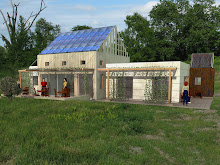
Last week, we received a thrilling email from the US Green Building Council that our new residence, The Unity House, received the highest rating as an energy efficient, zero carbon dwelling. LEED Platinum is a significant accomplishment for Unity College.

The Unity House is one of 200+ residences nationwide rated LEED Platinum. (LEED stands for Leadership in Energy and Environmental Design) We have one of four Platinum-rated buildings in Maine. We are the first college President’s residence in the country to be rated Platinum. We are proud of this accomplishment. This outstanding rating will draw national attention to Unity’s sustainability efforts.

I’m sitting in the Unity House on a sunny day in February, listening to the whir of the solar inverter as the sun shines down on the photovoltaic array. It feels good to be producing so much energy on a day when the wind is blowing at 20+ mph and the thermometer reading -5 degrees F. The cement floor is absorbing sun as well, helping to warm the air to a toasty 70 degrees by noon. The heat pump hasn’t clicked on since 7am.

As conscious as we are of the high performance aspects of this building, the actual comfort and efficiency never cease to amaze me. This house is a masterpiece of intentional integration…the ways in which each part supports the other is the secret to its success.

The passive solar heat captured when the sun is out depends on the thermal envelope to securely hold the heat inside. The heated air and the thermal envelope are aided by the thermal mass of the house, which is designed to absorb heat and slowly radiate it out into the rooms after the sun goes down. The 8 inches of insulation, in tandem with designated ‘chases’ that hold plumbing, wiring and heating mechanics, eliminate thermal bridging in the walls…air cannot seep or creep into the house along wires or mechanical devices. (if you put your hand in front of a light socket on an outside wall in another building…you’ll usually feel cold air.)

My favorite thing about the house is having visitors come into the space for the first time. One of the Unity professors just brought her Environmental Citizen classes over for an introductory tour. 26 young minds opened to the concept of living comfortably in a sustainable house. Their initial reservations about ‘sacrifice and rationing’ shifted to embrace the benefits of the passive and active solar gain, the warm wood-paneled (100% recycled) interior, the ‘secret-life’ of the high-performance elements, life-cycle innovations of material use and the aesthetics. Planting ideas in this new generation of leaders will lead the way to a greener future.

Some students dropped to the floor to touch the cement and wonder at its warmth – assuming that cement will be cold in winter. They shake their heads at the use of Advantech (oriented strand board made from ‘junk’ wood) as paneling in the living room, which is usually is hidden from view in attics or used as sub-flooring. In this house, it is sanded and oiled to look like marbleized wood. The black kitchen counters draw attention for their elegance, hiding the fact that ‘paper-stone’ is 100% post-consumer recycled paper. There are many surprises in this house that all add up to a wonderful aesthetic. Living in the Green House is all about opening minds to new ways of using materials – living virtuously and frugally while in great comfort!

The mechanical room grabbed the interest of many as they investigated the solar inverter and the solar hot water heater. At first hesitant to wander around ‘the home of the president’, the students were soon exploring each aspect with vigor and amazement. We increased our prospects for Platinum LEED certification with our willingness to open the house for educational events. Each element of the house is designed to engage educational inquiry and the students actively engaged and asked excellent questions – leaving with a very different sense of how we might all live in a ‘green’ house. Living in the Green House is all about opening minds to new ways of using materials, producing energy and living lightly on the planet – in great comfort!

Cindy Thomashow

Monday, January 26, 2009

-15F But Now We're Really Counting!


The exceptionally cold winter continues. But there have been quite a few brilliantly sunny days and that allows for considerable solar gain for the passive design of the Unity House.

We had a retreat here on Saturday morning for the Faculty Planning Committee of Unity College. We're undergoing a thoughtful and wonderful process of revising our curriculum to meet the needs of a new generation of sustainability leadership. Mick Womersley, Associate Professor of Human Ecology, and generalist on all things related to ecological economics, energy and sustainability, was a participant. Before our discussions started, Mick was roaming around the house with a temperature gun, checking out the floors, windows, and walls. When I first saw him pull the thing from his pocket, I wasn't sure exactly what he was doing. Indeed, he looked like some kind of sustainability ghost-buster! Maybe that's an emerging career in this field.

Anyway, he told me what he was doing, handed me the thermometer gun, and I started flashing it as well, delighted in the simple pleasure of attaching numbers to walls and windows. Mick offered to lend me the instrument (Unity College has several of them). I took up his offer and spent Sunday (another icy cold, but clear day) taking readings throughout the day at approximately two hour intervals.

Here's what I recorded. At 9 AM the temperature outside was -9 Farenheit. The south facing window, just catching a few rays of morning sun was 73 F and the north facing window at our back entrance was 43. I placed a chair in front of the south facing window. The upholstery was 89F (a nice place to get some heat on your back in the morning) whereas the other couches were 64F. I checked out the floor throughout the house and it ranged from 56-64F. The walls were 63-66. The room temperature was 63, our default setting. The Hallowell heat pump was off although it had been on earlier in the morning. Incidentally, it would not come on again until 10 PM as the house absorbed and contained so much heat during the day.

Here are the remaining readings. By the way, the cold floor spot is the only place in the house that receives no sun. For most of the day, the floor temperature is the same as room temperature, but much warmer in the sunny spots as the house accumulates sun.

10:30 AM 3F outside

Windows 49-85
Couches 71-113
Floors 54-68
Walls 65-67
Room 65

12:00 PM 19F outside

Windows 52-102
Couches 71-113
Floors 54-79
Walls 65-68
Room 68

2:30 PM 21F outside

Windows 55-108
Couches 73-104
Floors 55-81
Walls 65-70
Room 70

6:00 PM 20F outside (The sun has set)

Windows 49-56
Couches 66
Floors 53-73
Walls 65-66
Room 66

What do I conclude from all of this?

(1) The windows are doing a pretty darn good job and there isn't too much heat loss from them
(2) The walls absorb and retain sufficient heat as they are almost precisely the same temperature as the room
(3) The floors effectively absorb and radiate heat
(4) The furniture temperature reflects room temperature, but absorbs heat when in direct sunlight.

What we should do next is trace the power needs throughout the course of the day.
More importantly, interacting with the house in this way helps us better understand the performance of the house.
Yet there's something very important that's missing here. What is the relationship between how the Unity House uses power and the regional/national grid?

I'm delighted to see that Thomas Friedman's excellent new book, Hot, Flat and Crowded is a national best seller. It's an insightful and accessible plea for a comprhensive national strategy for energy innovation as a means for America to regain its leadership in the global economy. Friedman also understands the challenge of biodiversity and climate change and he provides brilliant solutions-based, practical, and wide-ranging policy suggestions. I was so impressed with the book that I gave copies to every Unity College Board of Trustee and I'm using it in a seminar I'm teaching on Environmental Security.

Back to the temperature gun and the necessity of measuring power input and output as well. Friedman describes how America needs an "Energy Internet" which will allow comprehensive monitoring of energy usage. This will not only allow us to conserve unprecedented amounts of energy, but it will allow the consumer to take part in a community/cooperative venture that brings energy usage to the most specific and tangible consumer level.

We thought about wiring the Unity House accordingly, but the cost was prohibitive, and we decided that we'd rather invest in ecological landscaping and other features. However, the technology should be available for every American homeowner to have utility-provided "black boxes" not unlike your cable or satellite TV setup that are connected to both your computer and the national grid. The whole point of the Unity House (and other sustainable energy projects) is to live experimentally, live with more energy awareness, and to take educational leadership to promote sustainable alternatives.

As we learn more about the Unity House, we will take on some of these initiatives. we'll look for inexpensive energy monitoring alternatives, and we'll report on what we're learning. We'll continue to pursue what one reporter described as "obsessive transparency."

Oh, and as you can see, our dog Paco really likes sitting on a warm couch on an icy cold winter day!

Saturday, January 17, 2009

-15 and counting

We've lived in Northern New England for the last thirty years, mainly in Dublin, New Hampshire, in the shadow of Mount Monadnock. Our small house in the hills (which we still use and own) is perched on the side of a hill so we never experienced incredibly frigid temperatures. It would be ten or twenty below in Keene (a Pleistocene lake bed), but at our house the temperature would be at least ten or fifteen degrees warmer. Indeed, the coldest temperature we ever recorded from 1979-2006 was about ten below zero, and the number of evenings below zero (in total over all those years) was surely less than twenty.

The last few days all of Northern New England has experienced some of the lowest temperatures I've ever seen. This morning at 9 AM it was -15. I went out snowshoeing for twenty minutes just to say that I experienced that temperature. I really enjoy extraordinary weather, as long as its short-lived.

But more to the point, how are things at the Unity House? Usually if the temperature is that cold it's because there's enough radiational cooling for the heat to escape into the atmosphere. We've experienced three consecutive frigid, but largely cloud-free days. By 9AM the solar gain is sufficient in The Unity House that the electric heat pump will not be needed again until about 8 PM. Yesterday it was a balmy seventy degrees. There is no draft of any kind as the house is so well insulated. Hence on brilliantly sunny days (even when the temperature doesn't rise above 5 Degrees Farenheit, there is no need for electric heat until well into evening. Also, the solar panels are generating about 4500 Watts of power. I can safely say that when the sun is shining in the middle of winter, the Unity House is carbon neutral.

Still, we have slipped behind on our scorecard. As of yesterday, we have drawn more energy from the grid than we've generated, but not by much. I fully expect that as the days get longer and warmer we will redress the balance and wind up way ahead.

It's time to leave the computer, head over to the chair by the window, and soak up some of that mid-Winter sun as I gaze over the frigid landscape.

Mitchell Thomashow

Wednesday, December 24, 2008

Solstice


The Unity House is facing it's first major challenge—the depths of winter! Over the last three weeks, we've had about three days of sunshine, a 20 inch snow storm (with 40 mile per hour winds), an ice storm, snow showers, sub-zero cold, and the shortest days of the year.

For the first time since we've moved in, we have used more electricity from the grid then we've generated from the solar panels. We expected this would happen. Remember that zero-carbon is our year-round total. Based on our observations thus far I think we'll easily come out ahead with our annual carbon accounting.

On the few brilliantly sunny days we've had, even when the temperature never climbed above 15 degrees Farenheit outside, passive solar gain heated the house to about 68 degrees F and we didn't use the electric heat pump at all. The house kept the heat well and it dropped to 63 degrees F just as we were about to go to sleep. On those sunny days, we generated as much electricity as we used. So the challenge is to get through the clouds and snow.

Even on the day of the almost-blizzard, the house is so tight that we never felt any drafts.

That's our report from the first few weeks of solstice winter.

Mitchell and Cindy

Monday, December 1, 2008

"Campus into Canvas" with the Art of Stewardship

Earlier this month, we had a conference on the Unity College campus called the Art of Stewardship. 55 people braved the damp November weather to help us turn ‘campus into canvas’…identifying ways to use art as a medium to engage residents and visitors in thinking about stewardship and sustainability. The Unity House was their first destination and our first big event in this public/private space…a test of its versatility and function.

The designers gave specific attention to “optimizing the thermal envelope and minimizing the space needed to accommodate various sized groups of people” creating transformable spaces within the house. The wall between the guest room and the gathering space/living room folds up, providing another 270 square feet for entertaining. We didn’t use it this time…opting to use the guest room as an entry area in the wet weather. But, the flexibility of the interior got a real workout – passing with flying colors.

The intimate living place, where we sit each night and play board games, was easily converted into an amphitheater as 55 folding chairs filled the space. We had a catering table, a registration table and a whole lot of bodies comfortably gathered for the beginning of this wonderful event. The house served as a focal point for discussions about sustainability and comfort…about possibilities of merging beauty with functional green design. The details within the space are lovely and never cease to surprise visitors who expect sustainability to equal stark, ascetic simplicity.

The interior is warm and inviting for many reasons that include both the technical and the aesthetic. The colors are a warm collection of brown tones with big timbered beams and high ceilings. The floor is a brown acid-stained concrete that looks so soft that people frequently bend down to feel the texture. The technical aspects include the thermal envelope that amasses warmth from the sun in the walls, floor and ceiling. Heat radiates back into the room from these ‘collectors’ without leaving cold spots… inhabitants feel comfortable even on cloudy days. I watched the temperature rise during the morning session. 55 bodies throw off a lot of heat! The temperature rose about seven degrees during the two hours, which kept us from turning on the heat for two days. Thermal mass and an insulating R value of 43.85 makes an enormous difference in the quality of heat we experience here.

I thought I would miss the ‘hot spot’ that a wood stove provides. And, most of the people during the event asked whether we did miss the central heat force in our lives. We spent 30 years using wood as our main fuel source. We thought about adding a masonry wood stove to this design but our goal of ‘net-zero’ would have suffered. So, we went with a passive design, which includes about 24 feet of glass on the south side of the house and concrete floors. Our roof has a 5.4 KW PV array and solar domestic hot water system to insure our supply of electricity should we need to turn on the Hallowell heat pump. So far, we are still producing more energy than we use on a daily basis. We will see what winter in Maine brings…but I have faith in our ability to budget our energy use wisely. If we can do it in Maine, it is probably possible anywhere!

Cindy and Mitchell Thomashow

Wednesday, November 5, 2008

A Daily Discovery -- Unity House, the Experience of a Lifetime

It is early November in Maine. Mitchell and I are living in the new ‘zero carbon’ solar house designed and built for Unity College by Bensonwood Designs in NH. We’ve been in the house for about 6 weeks. The leaves are off the trees and frost covers the ground most mornings. The temperature this time of the year ranges from about 29 degrees at night to about 50 on a sunny day. We have yet to use our heat. This high performance house is designed to hold heat and to produce it passively. The south-facing wall is made up of big sliding triple-paned glass doors. The sun shines in on stained concrete floors. The mass of concrete holds enough heat from a day of sun to radiate warmth through the house all night long. We go to sleep with the house at about 67 degrees and when we wake up it is the same. We also have a significant array of solar panels on the roof.

At about 6am every morning the back door opens and I hear Mitchell’s feet crunching across the stones on his way to the electric meters. He dutifully records the kilowatts produced by our solar panels and compares them to the electric energy coming in to the house from the grid at night when the sun is down. I hear an excited whisper…"we are still way ahead!" I already know that from the inside monitor but, he is a purist…the outside meter records the amount of energy we have produced after the house takes its share and before it goes back to the grid. It shows the extra energy we are producing – after we have spent electricity cooking, cleaning, playing music and computing.

Every morning, I look at the meter hanging in the living room. It is in plain view for every visitor to see as an educational experience. Building this house and living in it is a commitment to change. Both Mitchell and I believe that all of us need to rethink how we use resources, how we participate in conservation and how each person responds to the challenges of climate change.

In addition to the kilowatt-hours we have produced, the inside meter provides a record of the money saved by the solar panels and records how many pounds of carbon we have kept out of the atmosphere. This information is very satisfying. Today, for example, we produced 33 kilowatt hours, saved four dollars on our electric bill and kept 42 pounds of carbon from being released in to the atmosphere…not a bad day’s work! The last electric bill showed a nine dollar service call and a substantial credit.

About once a week, someone drives down the driveway drawn in by the solar array that is visible from the road. As my office is in the Unity House, I greet them and offer information about the house. This house is of great interest to people who are trying to find a way to become independent of Oil and are frustrated by high oil bills for winter heating. We are committed to educating the public about this style of living.

As one visitor said, “Everyone should be living like this!” and went on to publish the attributes of the house on his website. He is right. We all should be living like this…it is easy and right. The current state of the planet demands that we rethink our lifestyles. Mitchell and I are comfortable, warm and surrounded by aesthetic beauty in this high performance building…no sacrifices…only amazement at how comfortable living in a zero-carbon, zero-oil environment can be.

Cindy Thomashow, Director, Center for Environmental Education Online

Unity House. More than a sustainable solution, it's an educational opportunity

At Unity College we believe that climate change, threats to biodiversity, and habitat fragmentation are the most important challenges of our era. Our “environmental security” has ramifications for the global economy, international policy, and the quality of life. We believe that our colleges and universities must respond to this crisis by promoting sustainable alternatives at every level of campus life. This makes both ecological and economic sense.

We are challenged, inspired, and motivated by the emerging level of national commitment to sustainable solutions. In particular, we note how American colleges and universities are taking a leadership effort. Unity College is a charter signatory of the
North American Colleges and University Presidents Climate Commitment.

This organization is mobilizing campuses around America to dramatically reduce their carbon footprint, promote sustainability education, and develop partnerships that promote the business of sustainability.

Similarly we are buoyed by the extraordinary efforts of the
American Association for Sustainability in Higher Education which supports sustainable solutions for campuses, businesses, and institutions.

In our view, nothing could be more relevant for University Business than serving to promote, broker, and encourage this important movement.

One month ago, my wife Cindy and I moved into The Unity House, a zero-carbon solar residence. In partnership with Bensonwood Homes and the MIT School of Architecture, this home is the second project of the
Open Prototype Initiative.

This extraordinary effort seeks nothing less than to change the future of American housing by producing modestly priced, comfortable, ecologically sound homes that are durable, resilient, and beautiful. Please check out the
Bensonwood website to learn more about the technical aspects of the house or to learn more about their cost and availability.

We’ve been living in The Unity House for about six weeks. The really, really, good news, is that the house is performing brilliantly and it is an absolute pleasure to live in. We don’t have to wait for the future of housing. It’s here right now! We can’t think of a better way to simultaneously solve the housing crisis and reduce our carbon footprint. Let’s build (and retrofit) houses that are truly ecologically sustainable and very affordable!

Two and a half years ago, just before I took the job as the president of Unity College, another college president gave me some reassuring and inspirational advice. Helen Giles-Gee, the President of Keene State College told me that “being a college president will be the greatest opportunity you will ever have to be an educator.”

The Unity House is more than just a sustainable solution. It’s a wonderful educational opportunity. We are hoping that the countless visitors to the house will be impressed, inspired, and motivated to live similarly. We hope that they contact Bensonwood if they wish to live in a similar home, or try their hand at their own designs, or provide us with suggestions about how we can improve our own ecological and energy habits. We encourage you to read
Tedd Benson’s blog as well.

In the weeks to come, Cindy and I will discuss various aspects of living in The Unity House. I will focus on some of the broad philosophical challenges related to sustainability and higher education. Cindy will write about the day to day experience of living in The Unity House—how it changes our energy habits, how it makes us more aware of our footprint, how it makes us better learners and teachers. And we will have some guest appearances from some of our visitors. Please do participate with your comments and questions. That’s the point of a blog—to promote discussion, controversy, and dialogue!

Mitchell Thomashow, President, Unity College